Living Room Legends: How Hosting a House Concert Just Became the Coolest Thing You Can Do With a Weekend
Let's be honest — the last time you paid serious money for a concert ticket, you probably spent half the night squinting at a tiny figure on a stage a quarter-mile away, nursing a $17 beer, and wondering if this was really how you wanted to spend your Saturday. The spectacle was there. The connection? Not so much.
Something's shifting, though. Across the country, a quieter — and honestly way more interesting — music scene is popping up in apartments, backyards, and living rooms. House concerts are back. And this time, they're not some hippie throwback or niche folk thing. They're becoming one of the most sought-after social experiences for people who actually care about music and the people they share it with.
What Even Is a House Concert?
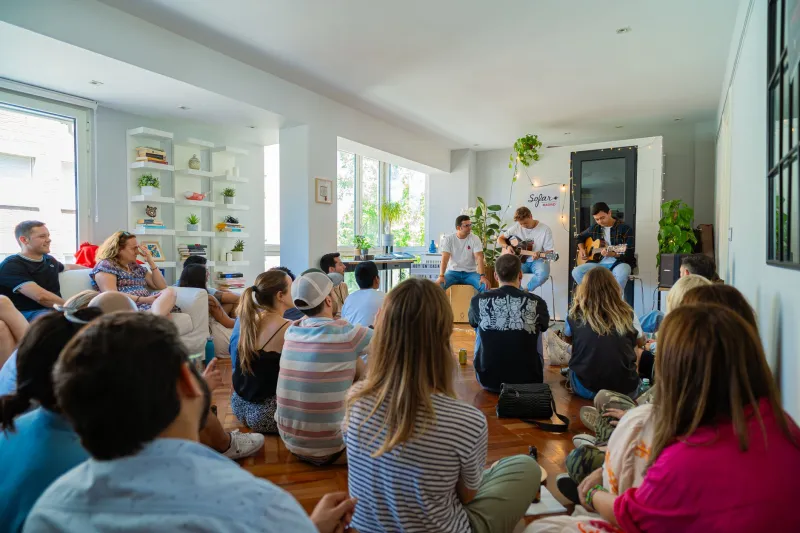
If you haven't been to one, here's the deal: a house concert is exactly what it sounds like. Someone opens up their home, invites a group of friends (or sometimes strangers), and a musician — could be a local artist, a touring indie act passing through town, or even someone you found on Instagram — performs a short set in an intimate setting. Think 20 to 60 people max. Folding chairs, maybe some candles, definitely snacks, and zero barrier between you and the performer.
No security guards. No merch table the size of a convenience store. No opening act you've never heard of playing for 45 minutes while you're still trying to find your seat. Just music, people, and a vibe that a 20,000-seat arena simply cannot manufacture.
The Economics Are Actually Wild (In a Good Way)
Here's where it gets interesting from a pure numbers standpoint. Major concert tickets have gone absolutely feral in pricing over the last few years. Between dynamic pricing, Ticketmaster fees, and resale markups, seeing a mid-tier artist at a decent venue can easily run you $150 to $300 before you've even thought about parking or drinks.
House concerts flip that script entirely. Most hosts charge a suggested donation — typically somewhere between $15 and $40 per guest — which goes directly to the artist. No middleman. No platform cut eating half the revenue. Artists who perform the house concert circuit often say they walk away with more money from a 40-person living room show than they do from a 300-person bar gig where the venue takes a massive percentage.
For the host, the cost is mostly covered by that door donation, maybe some drinks and snacks, and whatever energy you put into setting up the space. For guests, it's an affordable, genuinely memorable night out. Everybody wins, and nobody's selling a kidney for floor seats.
The Emotional Math of Small Spaces
There's something that happens when a musician is eight feet away from you and making eye contact. It's uncomfortable in the best possible way. You can't scroll your phone. You can't disappear into the crowd. You're just... there, fully present, and the music lands completely differently because of it.
Psychologists who study live performance have long noted that proximity to a performer increases emotional response — people feel more connected to the music and to each other when the physical distance collapses. House concerts weaponize this effect. Artists tend to play looser, talk more between songs, share stories they'd never tell into a stadium mic. The whole experience feels less like a product and more like an actual moment between humans.
For Gen Z and millennials who are increasingly craving authenticity over spectacle, that distinction is everything. It's the difference between watching a highlight reel and actually being in the room.
How People Are Actually Finding Artists
This is where social media earns its keep. Platforms like Instagram, TikTok, and even newer community apps have made it surprisingly easy to discover emerging local musicians who are actively looking for house concert bookings. A lot of artists explicitly mention in their bios that they're available for private shows. Some use Bandcamp or personal websites with a booking inquiry form. Others are findable through local Facebook music groups, Reddit threads for specific cities, or community boards on apps like Nextdoor.
There are also platforms like Sofar Sounds that have been quietly running an organized version of the house concert model for years — connecting artists with hosts in cities across the US. While Sofar has its own structure and aesthetic, it's helped normalize the idea and introduced a lot of people to the format who then went off and started doing their own thing independently.
Word of mouth still matters enormously here, too. If you go to a great house show, you tell people. The host gets a reputation. The artist gets more bookings. It's a grassroots ecosystem that runs almost entirely on personal recommendation and genuine enthusiasm, which is kind of refreshing in an era where everything feels algorithm-driven.
How to Actually Host One
The barrier to entry is lower than you'd think. You don't need a mansion or a dedicated music room. People have hosted successful house concerts in studio apartments, on rooftop terraces, in garages, and in suburban backyards. What you actually need is:
A space that fits people comfortably. Thirty guests in a living room works. Sixty guests in a backyard with a string light setup? Even better.
An artist you're genuinely excited about. Reach out directly. Most emerging musicians are incredibly responsive and often grateful for the opportunity. Be clear about your space, your expected guest count, and what you're offering in terms of the door donation split.
Basic logistics sorted. Seating (even floor cushions count), decent acoustics (rugs and soft furniture help), and a clear signal to guests about the vibe — this is a listening experience, not a background noise situation.
A guest list that's actually curated. The best house concerts happen when the people in the room are there because they want to be, not because they got a mass text. Invite people who'll be present and engaged. It makes a difference.
The Vibe Economy Is Real
What's happening with house concerts is part of a bigger cultural shift. People are increasingly skeptical of manufactured experiences and willing to put in a little effort to create something that feels genuinely theirs. Hosting a house concert signals something — that you care about music, that you have a community worth gathering, that your home is a place where real things happen.
That's a flex, but it's the kind that actually means something. Not a flex for the 'gram (though yes, it photographs beautifully), but a flex in the original sense — a demonstration of taste, generosity, and the ability to pull people together around something worth paying attention to.
The $200 stadium ticket will always exist. The lights, the production, the shared spectacle of 20,000 people screaming the same lyrics — that has its place. But if you want music that actually moves you, in a room full of people who are just as tuned in as you are, with an artist close enough that you can see their hands on the strings?
Your living room is waiting. Start making calls.