Going Out Without the Booze: Why Sober-Curious Spaces Are Becoming the Hottest Ticket in Town
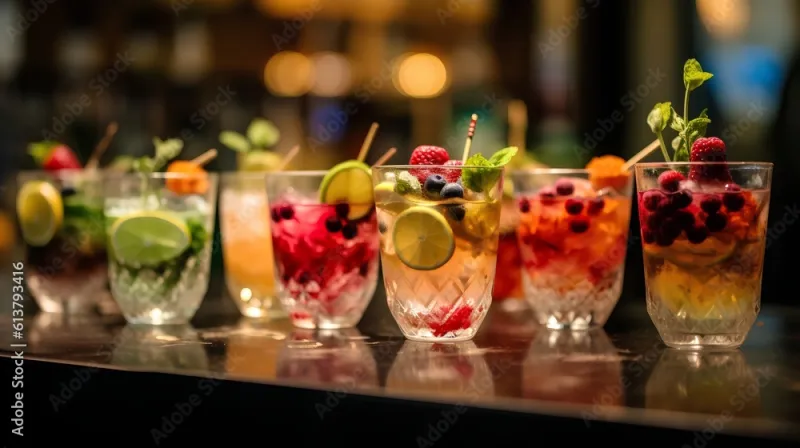
Photo: modern social lounge young adults non-alcoholic cocktails colorful mocktails nightlife, via as1.ftcdn.net
For a long time, "let's go out" in America meant one thing: find a bar. Maybe a club if you were feeling ambitious. The social script was tight — you dressed up, you stood in line, you paid $16 for a drink, you shouted over music you didn't really like, and you called it a good night. It worked, more or less, until it kind of didn't.
Something has been quietly shifting in how younger Americans think about nightlife. Not a rejection of fun — far from it — but a recalibration of what fun actually looks like. And across cities from Brooklyn to Austin to Los Angeles, a new category of venue is filling the gap: spaces built entirely around the experience rather than the alcohol.
The Data Behind the Drift
This isn't just vibes journalism. The numbers back it up. According to a 2023 NielsenIQ report, nearly 61% of American adults aged 21-34 are actively trying to reduce their alcohol consumption. Meanwhile, the non-alcoholic beverage market in the US crossed $11 billion in 2023, growing at a rate that has legacy beer and spirits brands scrambling to catch up.
Gen Z, in particular, is drinking less than any generation before them at the same age. But here's the nuance that often gets lost in the headlines: they're not staying home. They still want to go out. They still want the ritual, the social electricity, the outfit moment. They just want the experience to be the main event — not the alcohol.
"People used to come here for the drinks and stay for the atmosphere," says Marcus Webb, co-owner of Groundwork, an immersive game bar in Chicago that stocks an extensive zero-proof cocktail menu alongside its full bar. "Now I'd say it's flipped. People come for the experience and the drinks — whatever kind — are secondary."
What Experience-Driven Nightlife Actually Looks Like
The term "experience-driven" gets thrown around a lot, but in this context it means something specific: venues where the activity or atmosphere is the draw, and alcohol is optional rather than central.
This plays out in a few distinct formats across the US right now.
Immersive Game Bars like Punch Bowl Social (with locations in Denver, Detroit, and beyond) or the wildly popular Fowling Warehouse in Michigan are built around activities — bowling, darts, pinball, giant Jenga, foosball — with full bars attached but no pressure to drink. You're there to play. The drinks are a side quest.
Speakeasy-Style Coffee Shops are having a serious moment in cities like Portland, Nashville, and New York. These aren't your standard third-wave espresso spots — they're designed with nightlife aesthetics in mind. Low lighting, craft cocktail-style mocktails, late hours, curated playlists. Places like Blank Street Coffee in NYC have started hosting late-night events that feel more like gallery openings than coffee runs.
Wellness Lounges and Kava Bars are perhaps the most interesting category. Kava — a root-based drink from the Pacific Islands with mild relaxing properties — has become the unofficial mascot of the sober-curious nightlife scene. Kava bars like Bula Kava House in Portland or the growing Botánico chain in Texas offer a ritual-heavy, social drinking experience that mimics bar culture without the alcohol. You sit at a bar, you order rounds, you stay for hours. The vibe is almost identical. The hangover is not.
Immersive Art and Entertainment Venues like Meow Wolf (with permanent installations in Santa Fe, Denver, and Las Vegas) or the traveling Van Gogh experience have become legitimate nightlife destinations for groups who want something to talk about beyond "what are you drinking?"
FOMO Without the Fumble
One of the biggest barriers to not drinking in traditional bar settings is social FOMO — the feeling of being slightly outside the ritual, holding a soda water while everyone else clutches a craft IPA. Experience-driven venues dissolve that tension by making the activity the social equalizer.
When you're all trying to escape a puzzle room, nobody's tracking what's in your cup. When you're competing in a fierce round of Skee-Ball, the leaderboard is the only social currency that matters. This design choice — intentional or not — creates genuinely inclusive social environments in a way that traditional bars often struggle to.
"I used to dread going out with work people because I don't drink and it always felt awkward," says Priya, a 28-year-old UX designer in Austin. "Now I just suggest an axe throwing place or a trivia night and it's a totally different dynamic. Nobody cares what's in your glass because we're all focused on the same thing."
Venue Owners Are Paying Attention
The business case for this shift is increasingly hard to ignore. Non-alcoholic drinks carry significantly higher margins than their boozy counterparts, and experience-based revenue — entry fees, equipment rentals, event packages — is far more predictable than bar tabs.
Jessica Tran, who opened Lunar, a wellness-forward social lounge in Los Angeles in 2022, says her business model was built around the experience-first philosophy from day one. "We offer adaptogens, functional mocktails, a meditation room you can book for 20 minutes, and a full events calendar. Alcohol is on the menu but it's not the draw. Our regulars come because they want to feel good after a night out, not just during it."
Tran says her weeknight bookings — historically the dead zone for traditional bars — are consistently strong. "People who are prioritizing their wellness don't stop wanting community. They just want the community to support that, not undermine it."
What This Means for the Future of Going Out
None of this signals the death of the bar. Bars are fine. Bars are great, actually. But the cultural monopoly that alcohol has held over American social life — the idea that a night out requires drinking to count as a real night out — is genuinely loosening.
What's emerging is a more pluralistic nightlife ecosystem, one where the question "what do you want to do tonight?" has a much wider range of legitimate, exciting answers. Axe throwing. Kava bar. Immersive art. Trivia league. Pottery class that ends at 10pm with wine or sparkling water. The emphasis is on shared experience, not shared intoxication.
For a generation that grew up curating their identities online, this makes complete sense. The night out is content, it's memory, it's story. And increasingly, the best stories don't start with "so we were at this bar..."
They start with: "okay, you're not going to believe what happened at this place we went to."